Teaching Agents to Draw and Animate
Agents can write almost anything now. Ask for a screen and you get a screen. Ask for a backend and you get a backend.
Ask one to draw a person, and things fall apart. Stick arms. Beads for hands. A head sitting on the shoulders like a ball on a shelf. Ask it to make that person feel alive, and it gets worse: the face jumps from one expression to the next, the body stops dead at every pose, and everything moves in sync, like a machine.
I ran into this building the illustrations for my own app. The onboarding is full of characters, and every one of them was supposed to breathe. So I kept saying the same things to an agent. No, the arm is thicker. No, the pupil slides, it doesn't jump. No, that blink is too fast, it flickers.
At some point I stopped repeating myself and started writing it down.
A skill is a file an agent reads before it starts working. Mine are every correction I made, turned into a rule, with the reason next to it.
taste, written down
Drawing people
The first one is duolingo-character-style-skill. It draws people in Duolingo's flat illustration style, the round, friendly look everyone recognizes.
I didn't guess the proportions. I measured them from the vector drawings in Duolingo's own brand guide: how wide the head is, how thick the arms are, how big the hands are, where the shoulder hides, the shape of the eyes. The skill ships those numbers, plus a table of the mistakes agents make and the fix for each one.
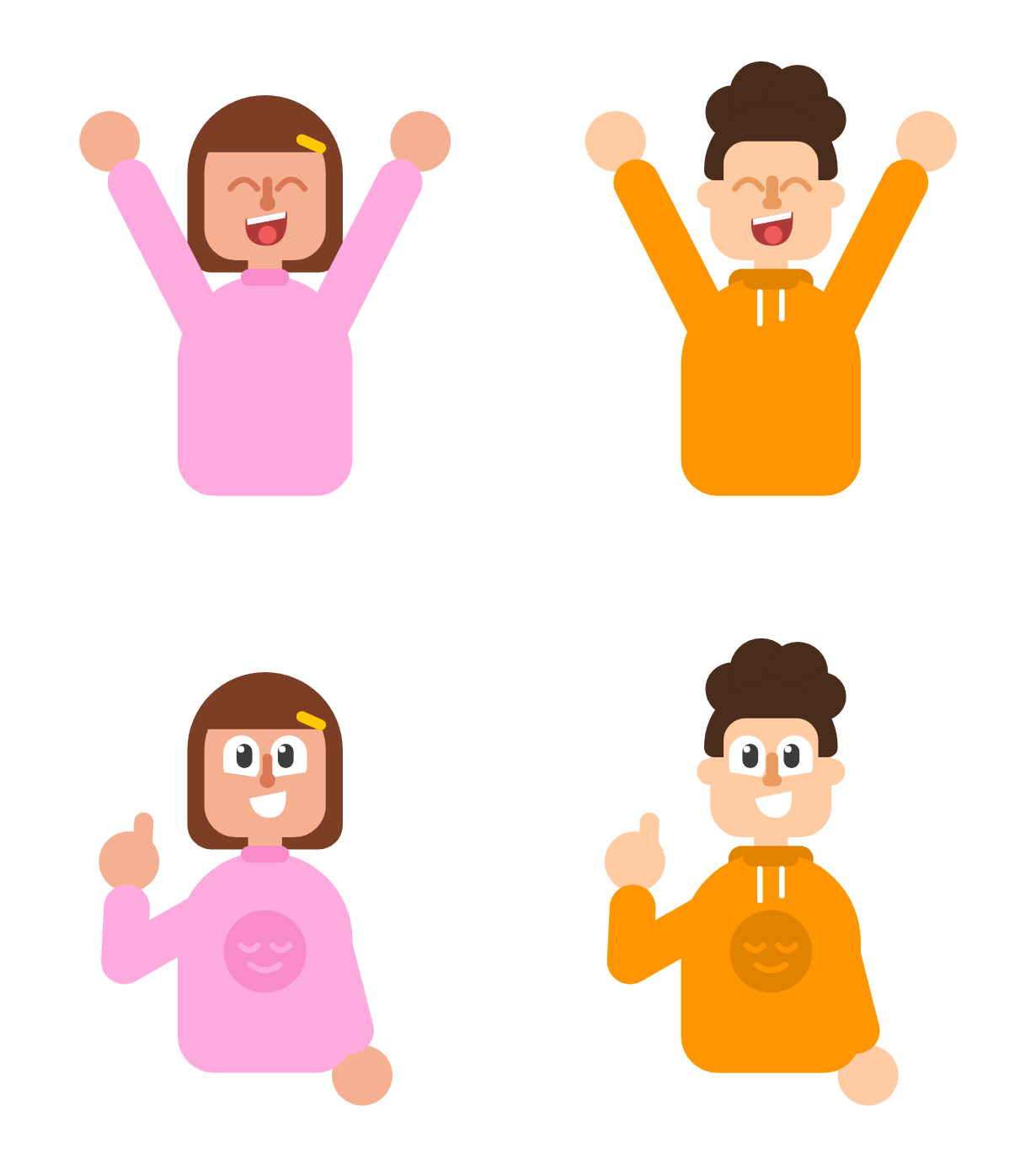
It's a style guide for original characters. It doesn't copy Duo or the rest of the cast, and it tells the agent not to.
Making them move
The second one is rossark-motion-skill. It brings anything drawn to life: characters, plants, fire, water, weather, icons, whole scenes.
Nobody animated that kid by hand. It's code. A silhouette floats in with its feet hanging limp. The kid drops, squashes on the landing, spots a ball rolling in, kicks it, then turns to you and waves. Every pose flows into the next, and the small life never stops: the breathing, the glances, the weight shifting from foot to foot.
What the skill teaches is the stuff that makes the difference:
- one clock for the whole scene, so nothing drifts;
- a smooth path through the key poses, instead of a separate tween for each one that stops dead;
- parts that trail a beat behind, like the head and the hands;
- blinks that close fast and open slower, so they read as soft instead of a flicker;
- small amplitudes and strong curves.
It also teaches the agent to measure a reference before copying it. Give it a video and it reads the motion frame by frame. The jiggle that makes something look alive is often 2% of its size. You can't see that by watching. You can by measuring.
For motion inside an interface, it follows two people whose taste I trust: Emil Kowalski and Benji Taylor.
It works with React Native and SwiftUI, and the method carries over to the web. For a lot of what I used to open Rive for, a mascot that blinks and breathes, a scene that loops, this is now enough. It's just code, there's no extra runtime, and a change is one sentence to an agent.
Use them
Both are public on GitHub and free to use.
npx skills@latest add rossark0/rossark-motion-skill
npx skills@latest add rossark0/duolingo-character-style-skill
Then ask your agent to draw something, or to make it feel alive.
If you make something with them, show me on X. I want to see it.
With love, Ross.